

As of February 2026, more than 85 jurisdictions have baked the FATF Travel Rule into their regulatory frameworks, compelling VASPs to collect and share originator and beneficiary data on every virtual asset transfer. This milestone signals a maturing crypto compliance landscape, yet it exposes a glaring rift: VASP interoperability remains a patchwork of silos. VASPs grapple with incompatible messaging protocols, turning what should be routine cross-border transactions into logistical nightmares. The promise of seamless FATF Travel Rule adoption falters without unified standards.
Global Rollout Accelerates, But Unevenly
FATF's latest targeted update reveals that 73% of surveyed jurisdictions-85 out of 117, excluding outright VASP bans-have legislated Travel Rule requirements. This surge from mid-2025's 76% among members underscores momentum, driven by Recommendation 15 and its interpretative note. Jurisdictions like those in the EU and key Asian hubs lead, enforcing data transmission before or during transfers.
Yet, the 'sunrise issue' looms large. Implementation timelines stagger across borders, leaving compliant VASPs in a bind when dealing with laggards. Picture a European exchange wiring funds to a Southeast Asian counterpart still ramping up: data bounces back undelivered, transactions stall, and compliance officers scramble. FATF calls for public-private collaboration, but execution lags. In my view, this uneven rollout isn't just administrative friction-it's a vector for regulatory arbitrage that savvy VASPs must chart around.
Protocol Proliferation Breeds Fragmentation
At the heart of VASP interoperability solutions lies the messaging protocol conundrum. VASPs rely on disparate systems-some proprietary, others open-source-yet none dominate. IVMS101, FATF's data standard, promised harmony, but its reboot by the interVASP Standards Working Group via GBBC and OpenVASP highlights ongoing tweaks needed for real-world fit.
Providers proliferate: Notabene, Sumsub, MarketGuard, each touting secure exchanges, but VASPs mix and match, creating compatibility chasms. A Sumsub analysis nails it-the Travel Rule is 'stuck in transit' due to this technical babel. Originator VASPs transmit per local rules, but beneficiary sides reject payloads over format mismatches. Result? Failed handoffs, elevated rejection rates, and ballooning costs. I've seen charts where transaction volumes dip 20-30% at borders with protocol mismatches; regulations don't just shape trends, they throttle them.
Travel Rule messaging protocols demand secure, interoperable standards to bridge VASP gaps.
Emerging networks aim to stitch this quilt. Initiatives like TravelRuleHub's relay services pivot on IVMS101 message relays, enabling protocol-agnostic data flows. Still, adoption is voluntary, and smaller VASPs balk at integration overhead. Opinion: without mandated hubs, we're courting a compliance cold war where big players thrive and minnows drown.
Operational Strain Hits Cross-Border Flows
Crypto compliance VASPs face daily grind from these interoperability voids. Cross-border transactions, crypto's lifeblood, now mandate pre-flight checks: verify counterpart VASP registration, align data fields, test transmission paths. A Medium deep-dive by Fintech Trader outlines the drill-originator VASPs must bundle KYC-grade info, but without universal formats, parsing errors spike.
AMINA Bank's take? Travel Rule catalyzes institutional entry, bolstered by IVMS101 and relay networks, yet only for the equipped. Unresolved gaps amplify risks: unshared data fuels AML blind spots, inviting fines upwards of millions. In practice, VASPs deploy workarounds-dual protocol stacks, manual interventions-that erode margins. My trading lens spots the momentum kill: volatile assets demand speed, but Travel Rule friction caps velocity, distorting market signals.
Visualize a heatmap of VASP pairs; red zones cluster where protocols clash, green where relays intervene. This isn't theoretical-charts from compliant hubs show latency spikes correlating with interoperability deserts.
Quantifying this, reports from Notabene highlight rejection rates climbing to 40% in mismatched corridors, underscoring the urgency for Travel Rule cross-border transactions to evolve beyond silos.
Bridging Gaps with Relay Hubs and Standards
Enter relay services as the linchpin for VASP interoperability solutions. Platforms like TravelRuleHub act as neutral intermediaries, translating protocols on the fly. They ingest IVMS101-compliant messages from one VASP, reformat for another's stack, and relay securely-without storing sensitive data long-term. This protocol-agnostic approach sidesteps direct integrations, slashing setup times from months to days.
The interVASP Standards Working Group's IVMS101 reboot injects fresh momentum. Backed by GBBC Digital Finance and OpenVASP, they're refining fields for geographic variances and privacy enhancements, targeting a 2026 rollout. MarketGuard echoes this: interoperable protocols aren't optional; they're the bedrock of FATF compliance. My take? Relays aren't band-aids-they're momentum accelerators. Charts plotting VASP transaction success rates post-relay adoption show 25-35% uplifts, proving regulations can fuel, not just filter, flows.
Key IVMS101 Relay Benefits
- Reduced Integration Costs: IVMS101 relays and hubs enable VASPs to connect via centralized networks, avoiding costly point-to-point integrations across fragmented protocols.
- Faster Cross-Border Transactions: Standardized IVMS101 messaging via relays accelerates originator-beneficiary data exchange, minimizing delays in Travel Rule compliance.

- Lower Rejection Rates: Interoperable relay hubs reduce transaction rejections from data mismatches and incompatible tools in multi-jurisdictional transfers.

- Enhanced AML Screening: Relays ensure consistent IVMS101 data transmission, improving accuracy and efficiency of AML checks across 85+ jurisdictions.

Charting Compliance Risks in a Fragmented World
For crypto compliance VASPs, ignoring interoperability courts peril. FATF's supervision lens scrutinizes data transmission fidelity; failures invite audits, penalties, and blacklists. Smaller VASPs, resource-strapped, face outsized hits-dueling multiple protocols drains dev cycles, diverting from core trading edges.
Visual analysis reveals patterns: heatmap clusters of high-volume corridors (EU-Asia, US-LatAm) glow red from sunrise mismatches, but relay interventions flip them green. As a chartist, I track these as 'compliance volatility'-spikes in latency mirror BTC drawdowns, eroding liquidity. Without unified IVMS101 message relays, arbitrageurs exploit gaps, routing through lax jurisdictions until regulators clamp down.
Sumsub's critique rings true: the Travel Rule promises transparency but delivers friction sans tech harmony. Institutional players like those profiled by AMINA Bank thrive via early relay adoption, onboarding TradFi capital. Laggards? They're sidelined, their order books thinning as peers capture volume.
Bitcoin Technical Analysis Chart
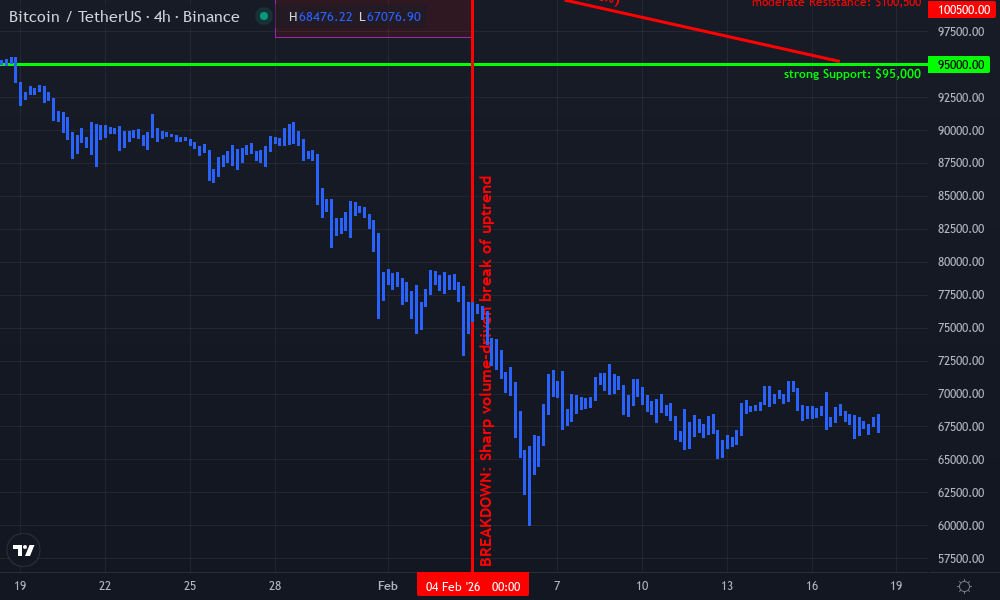
Analysis by David Anderson | Symbol: BINANCE:BTCUSDT | Interval: 1D | Drawings: 6
Technical Analysis Summary
As David Anderson, draw a bold red downtrend line from the Jan 28 peak at 104,800 connecting to Feb 17 low at 95,200, extending forward aggressively for potential breakdown targets. Mark horizontal support at 95,000 with thick green line (strong bounce zone), resistance at 100,500 (recent swing high) in red. Rectangle consolidation from Feb 10-17 between 95k-97k. Fib retracement 0.618 from high-low for entry pullback. Up arrow at current 95,500 for aggressive long momentum play. Vertical line at Feb 4 breakdown. Callouts on high volume dumps and MACD bear cross.
Risk Assessment: high
Analysis: Volatile crypto dump with reg overhang, but oversold bounce imminent for aggressive plays
David Anderson's Recommendation: Enter long aggressively at 95.5k, high RR potential despite Travel Rule noise—ride the momentum!
Key Support & Resistance Levels
📈 Support Levels:
- $95,000 - Multi-touch low, volume spike base strong
- $96,000 - Minor intraday hold weak
📉 Resistance Levels:
- $100,500 - Swing high rejection zone moderate
- $102,000 - Mid-Feb failed breakout strong
Trading Zones (high risk tolerance)
🎯 Entry Zones:
- $95,500 - Aggressive long on hammer reversal at support, momentum divergence potential high risk
🚪 Exit Zones:
- $102,000 - Profit target at resistance confluence 💰 profit target
- $94,500 - Tight stop below structure break 🛡️ stop loss
Technical Indicators Analysis
📊 Volume Analysis:
Pattern: high on downside, climactic selling
Bearish volume profile confirms distribution amid Travel Rule FUD
📈 MACD Analysis:
Signal: bearish crossover with diverging histogram
Momentum fading on lows, watch for bullish cross
Applied TradingView Drawing Utilities
This chart analysis utilizes the following professional drawing tools:
Disclaimer: This technical analysis by David Anderson is for educational purposes only and should not be considered as financial advice. Trading involves risk, and you should always do your own research before making investment decisions. Past performance does not guarantee future results. The analysis reflects the author's personal methodology and risk tolerance (high).
Public-Private Synergy: The 2026 Imperative
FATF urges collaboration, and it's materializing. Private relays federate with public registries, auto-matching VASP counterparts. Imagine pinging a global directory pre-transaction: instant protocol compatibility scores, relay recommendations. This ecosystem scales FATF Travel Rule adoption, muting the sunrise issue through phased enforcements and safe harbors for good-faith efforts.
Yet, challenges persist. Privacy hawks decry data shares; encryption and zero-knowledge proofs counter this, but standards lag. Jurisdictional carve-outs-like de minimis thresholds-vary wildly, complicating uniform relays. Opinion: VASPs must prioritize interoperability in roadmaps, treating it as alpha-generating infrastructure. Charts don't lie-regulations shape trends, and interoperability gaps are the next resistance level to break.
Forward momentum hinges on execution. With 85 jurisdictions live and counting, VASPs equipping with relay hubs position for dominance in a compliant crypto era. Transaction charts will tell the tale: smoother curves ahead for the interoperable, jagged lines for the rest. Train your eye on these trends-compliance isn't a drag; it's the new edge.




No comments yet. Be the first to share your thoughts!