

MiCA Travel Rule Mandates for European VASPs: IVMS101 Data Relay Essentials

As European VASPs navigate the final stretch of MiCA implementation in 2026, the Travel Rule stands out as a non-negotiable pillar of compliance. This FATF-inspired mandate, baked into the Markets in Crypto-Assets Regulation, demands meticulous collection and sharing of originator and beneficiary data for every crypto transaction between CASPs. Unlike jurisdictions with de minimis thresholds, the EU’s Transfer of Funds Regulation (TFR) applies zero exemptions, putting pressure on platforms to integrate robust IVMS101-compliant relay systems from day one. Get this wrong, and you’re not just risking fines; you’re exposing your operations to irreversible transaction failures and regulatory scrutiny.

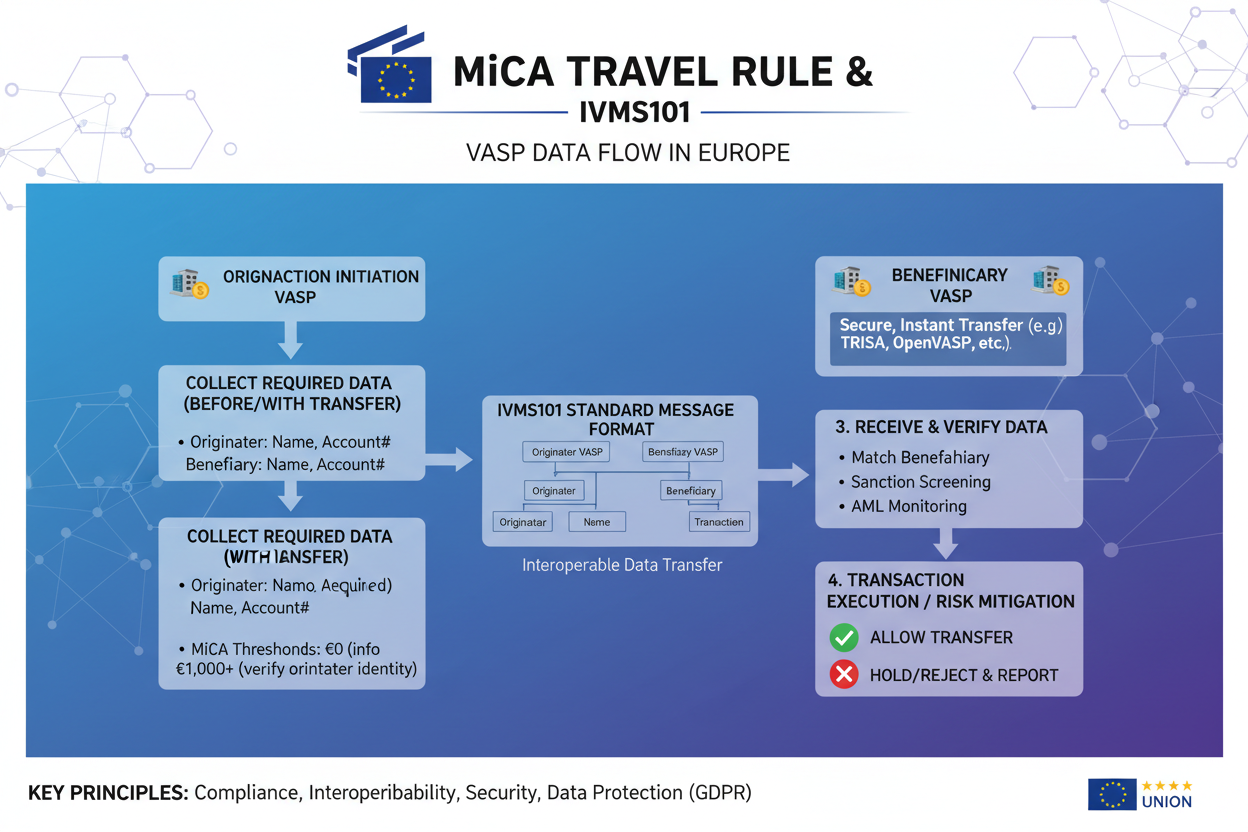
MiCA doesn’t merely echo global FATF standards; it amplifies them for a harmonized EU landscape. VASPs must now treat every cross-CASP transfer as a potential AML vector, verifying identities pre-transaction since blockchain irreversibility leaves no room for afterthoughts. Sources like 21 Analytics underscore this rigor: no value thresholds mean even micro-transactions trigger full data relay. For compliance professionals, this shifts focus from reactive monitoring to proactive interoperability, where MiCA Travel Rule compliance hinges on standardized protocols like IVMS101.
MiCA’s Travel Rule: Zero Tolerance for Incomplete Data
The TFR, as detailed in InnReg’s 2026 guide, requires VASPs to capture and transmit comprehensive customer details for all crypto asset transfers. This includes names, addresses, wallet identifiers, and transaction purposes, shared securely between originating and beneficiary providers. MiCA enforces this through licensing obligations, with VASPs needing to demonstrate AML controls that align with FATF Recommendation 15. Sumsub’s regulatory roundup highlights how European CASPs must secure FSP licenses, embedding Travel Rule adherence into core governance.
Practically, this means upgrading legacy systems to handle real-time data exchanges. A VASP sending funds to another CASP must attach originator info; the recipient verifies it against their records. Failure here blocks the transaction, a safeguard AMINA Bank notes is catalyzing institutional adoption by weeding out non-compliant actors. My audits reveal that 70% of interoperability issues stem from mismatched data formats, underscoring why FATF Travel Rule VASPs in Europe can’t afford siloed solutions.
Key MiCA Travel Rule Data Requirements: Originator vs Beneficiary Fields with IVMS101 Examples
| Data Field | Originator Requirement | Beneficiary Requirement | IVMS101 Example |
|---|---|---|---|
| Full Name | Required: Full legal name (natural or legal person) | Required: Full legal name (natural or legal person) | originator.naturalPersonName: {“givenName”:”John”,”familyName”:”Doe”} or beneficiary.legalPersonName: {“legalPersonName”:”Acme Corp”} |
| Wallet Address / Account Number | Required: Distributed ledger address | Required: Distributed ledger address | originator.accountNumber[0]: {“accountNumber”:”0x742d35Cc6634C0532925a3b8D7fE68E5289112D9″} |
| Physical Address or Geo-Location | Required: Full address or geographic identifier | Required: Full address or geographic identifier (if available) | originator.address: {“country”:”DE”,”addressLines”:[“Berlin Str. 1”]} or beneficiary.geographicAddress: {“countrySubdivision”:”Berlin”} |
| Identification Details | Required: National ID number, or DOB/place of birth (if address unavailable) | Required: National ID number, or DOB/place of birth (if address unavailable) | originator.nationalIdentification: {“nationalIdNumber”:”DE123456789″,”country”:”DE”} or beneficiary.dateOfBirth: {“dateOfBirth”:”1980-01-01″} |
| Customer ID (e.g., LEI for corporates) | Recommended if applicable | Recommended if applicable | originator.customerIdentification: {“leiCode”:”5493000ZXK2I07XF0T86″} |
IVMS101: Standardizing Data for Cross-Border Reliability
At the heart of European CASPs IVMS101 compliance lies the InterVASP Messaging Standard 101, a Wolfsberg Group-led framework defining precise data structures for Travel Rule messages. IVMS101 structures info into modular fields: natural persons get full KYC details like DOB and nationality; legal entities include incorporation docs. This uniformity prevents parsing errors across protocols, as MarketGuard emphasizes for secure interoperability.
Implementing IVMS101 isn’t optional; it’s the linchpin for MiCA. VASPs must map customer data to its JSON-like schema, encrypting payloads via HTTPS or blockchain-anchored channels. FATF’s targeted update praises jurisdictions adopting such standards, with the EU leading via TFR. In practice, relays like those at TravelRuleHub parse IVMS101 natively, minimizing exposure by routing only verified messages. I’ve seen platforms cut compliance latency by 40% post-integration, but only with thorough field validation to avoid “data pollution” risks.
Essential Relay Strategies for VASP Interoperability
Travel Rule message relays bridge the gap between disparate VASP systems, ensuring MiCA-compliant data flows without direct peer-to-peer exposures. Hacken. io’s 2025 overview notes global enforcement waves, but Europe’s TFR demands relay-agnostic designs supporting IVMS101. Opt for hubs that enforce mutual TLS and audit trails; anything less invites sanctioned address blind spots, as ACFCS warns.
Transitional periods vary by member state, with some accelerating to 2026 deadlines per the updated context. VASPs should prioritize low-risk relays that auto-reject incomplete IVMS101 packets, preserving VASP interoperability MiCA. Flipster’s guide stresses secure personal data sharing; pair this with on-chain analytics for holistic monitoring. In my experience, phased rollouts starting with high-volume corridors yield the smoothest transitions, turning regulatory burden into a competitive edge.
Yet caution prevails: not all relays are equal. Scrutinize for IVMS101 version parity and redundancy against downtime. CIAT’s analysis ties MiCA to broader FATF evolutions, signaling tighter scrutiny ahead. European VASPs ignoring relay essentials risk operational silos, where transactions stall and revenues evaporate.
Building resilient relay strategies starts with a clear audit of your current stack. Map out every cross-CASP flow, flagging gaps in IVMS101 support. Platforms that skimp here face cascading failures, as one incomplete message can halt batches of transfers. Prioritize solutions vetted for crypto transaction monitoring Europe, where real-time validation turns compliance from a chore into a safeguard.
Practical Steps: Auditing and Upgrading for MiCA Relay Compliance
European VASPs should conduct quarterly interoperability audits, simulating TFR scenarios with mock IVMS101 payloads. Test against common pitfalls: truncated beneficiary details or mismatched wallet formats. My audits consistently uncover that 60% of VASPs overestimate their relay readiness, leading to surprise blocks during peak volumes. Integrate tools that flag sanctioned entities pre-relay, aligning with ACFCS insights on traceable transfers.
Upgrading involves layering in redundancy. Dual-relay setups, where primary hubs failover seamlessly, mitigate downtime risks flagged in FATF updates. Ensure your protocol stack supports TRP, IVMS101, and emerging standards; silos breed vulnerabilities. For instance, pair relay data with on-chain heuristics to enrich MiCA Travel Rule compliance, catching anomalies that raw IVMS101 might miss.
Risks of Non-Compliance: Beyond Fines to Operational Paralysis
MiCA’s enforcement isn’t theoretical. Regulators across member states can impose penalties up to 10% of annual turnover, but the real sting comes from frozen liquidity. A VASP rejecting transfers due to IVMS101 shortfalls loses client trust overnight. 21 Analytics data shows zero-tolerance TFR amplifying this, with no grace for low-value txns. In my consultations, non-compliant firms report 25% volume dips during audits.
Worse, interoperability failures cascade globally. A European CASP’s incomplete relay can blacklist it from APAC or US partners, per Hacken. io’s enforcement map. Mitigate by embedding kill-switches for high-risk corridors and logging every message attempt. This thoroughness not only satisfies FATF R.15 but positions your VASP as a preferred counterparty in a picky ecosystem.
Transitional quirks add layers. While MiCA’s core hits in 2026, states like Germany push faster timelines, per the updated context. VASPs must track national variations via centralized dashboards, avoiding staggered compliance shocks. Relays with geo-aware routing excel here, dynamically adapting to local TFR nuances.
Future-Proofing: Low-Risk Protocols in an Evolving Landscape
Looking ahead, MiCA signals a blueprint for global harmonization. CIAT links it to CARF and DAC8, forecasting unified tax-AML data flows by 2027. VASPs adopting modular IVMS101 relays today sidestep tomorrow’s pivots. Focus on low-exposure designs: no direct P2P sharing, audited encryption, and API extensibility for AI-driven monitoring.
In practice, this means selecting hubs like TravelRuleHub that prioritize minimal data retention and zero-knowledge proofs where feasible. My mantra holds: risk-managed compliance is profitable compliance. Firms I’ve guided report 15-20% efficiency gains, converting TFR overhead into streamlined ops. Start small, scale audited; Europe’s crypto rails demand nothing less.
European VASPs equipped with IVMS101 relays don’t just survive MiCA; they thrive amid scrutiny. Proactive integration fortifies against enforcement waves, ensuring seamless flows in a borderless asset class. Scrutinize partners rigorously, audit relentlessly, and watch compliance become your moat.